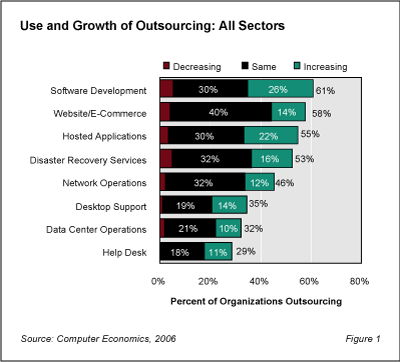
Outsourcing is not going away. You can delude yourself with myths of poor quality
and miscommunication all you want, but the fact remains that people are solving
those problems and making outsourcing work.
As Chad Fowler points out in
the intro to the section of
MJWTI titled "If You Can't Beat 'Em", when a
company decides to outsource - it's often a
strategic decision after much deliberation.
Few companies (at least responsible ones) would choose to outsource by the seat of their pants, and then change their
minds later. (It may be the case that we'll see some reversal, and then more, and then less, ... , until an equilibrium is reached - this is still new territory for most people, I would think.)
Chad explains the situation where he was sent to India to help improve the offshore team there:
If [the American team members] were so good, and the Indian team was so "green," why the hell
couldn't they make the Indian team better? Why was it that, even with me
in India helping, the U.S.-based software architects weren't making a dent
in the collective skill level of the software developers in Bangalore?
The answer was obvious. They didn't want to. As much as they professed
to want our software development practices to be sound, our code to be
great, and our people to be stars, they didn't lift a finger to make it so.
These people's jobs weren't at risk. They were just resentful. They were
holding out, waiting for the day they could say "I told you so," then come
in and pick up after management's mess-making offshore excursions.
But that day didn't come. And it won't.
The world is becoming more "interconnected," and information and talent crosses borders easier than it has in the past.
And it's not something unique to information technologists - though it may be the easiest to pull-off in that realm.
So while you lament that people are losing their jobs to cheap labor and then demand higher minimum wages, also keep in mind that you should be trying to do something about it. You're not going to reverse the outsourcing trend with
any more success than record companies and movie studios are going to have stopping peer-to-peer file sharing.
That's right.
In the fight over outsourcing, you, the high-paid programmer, are the big bad RIAA and those participating in the outsourcing are the Napsters. They may have succeeded in shutting down Napster, but in the fight against
the idea of Napster, they've had as much strategic success as the War on Drugs (that is to say, very little, if any). Instead of fighting it, you need to find a way to accept it and profit from it - or at least work within the new parameters.
How can you work within the new parameters? One way is to "
Manage 'Em." Chad describes several characteristics that you need to have to be successful with an offshore development team, which culminates in a "new kind" of
PM:
What I've just described is a project manager. But it's a new kind of project
manager with a new set of skills. It's a project manager who must act at
a different level of intensity than the project managers of the past. This
project manager needs to have strong organizational, functional, and technical
skills to be successful. This project manager, unlike those on most
onsite projects, is an absolutely essential role for the success of an offshore-developed
project.
This project manager possesses a set of skills and innate abilities that are
hard to come by and are in increasingly high demand.
It could be you.
Will it be?
Chad suggests learning to write "clear, complete functional and technical specifications," and knowing how to write use cases and use
UML. These sorts of things aren't flavor-of-the-month with Agile Development, but in this context, Agile is going to be hard to implement "by the book."
Anyway, I'm interested in your thoughts on outsourcing, any insecurities you feel about it, and what you plan to do about them (if anything). (This is open invitation for outsourcers and outsourcees too!) You're of course welcome to say whatever else is on you mind.
So, what do you think?
Hey! Why don't you make your life easier and subscribe to the full post
or short blurb RSS feed? I'm so confident you'll love my smelly pasta plate
wisdom that I'm offering a no-strings-attached, lifetime money back guarantee!
Leave a comment
Outsourcing is definitely here to stay. Or at least not until the companies are ready to work independently once again.
Posted by
BPO Manila
on Apr 04, 2010 at 11:58 PM UTC - 5 hrs
A lot of good points raised in this post. I do agree that outsourcing is here to stay and no matter how much we deny it, it will continue to grow over the years. I also believe that we do not have to lose out on this great opportunity - we just need to reinvent ourselves to go along with the trend.
Posted by Telemarketing
on Sep 14, 2010 at 02:38 PM UTC - 5 hrs
Outsourcing will only get to improve in the years to come. The BPO industry is set to grow as more and more companies go for saving money and time.
Posted by
Telemarketing Services
on Sep 28, 2010 at 12:26 PM UTC - 5 hrs
Because customers are looking for cheaper options, outsourcing will only grow from here... With it, these resources from abroad bring a different culture than what we're used to and can cause issues with moral levels to the team. Many projects have more than 50% of the total resources from outsourcing. Diversity plays an important role as we need to adapt to this new trend.
Posted by
SoftwareEngineerCareers
on May 04, 2016 at 03:26 PM UTC - 5 hrs