Today we'll start looking at the "Maintaining Your Edge" section of the book.
Chad starts off by explaining what can happen if you get too comfortable: Tiffany.
Not that Tiffany, this one:
Do you remember a pop star named Tiffany (no last name) from the 1980s? She was in the top of the top forty, and a constant sound on the radio back then. She enjoyed immense success, becoming for a short time a household name.
...
Apparently, if she tried, she didn't move fast enough to hold the affection -- or even the attention -- of her fans. When the tastes of the nation turned from bubble gum to grunge, Tiffany suddenly became obsolete.
The point remains: you need to stay sharp. You cannot sit back and become complacent. Doing so in this industry can cause you to become extinct. And you'll probably be less famous than Tiffany or the Dodo. However, Didus ineptus may end up describing you well.
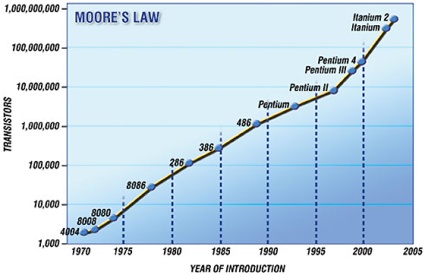
One thing you can do to stay sharp is recognize that, relative to information growth, your knowledge and skill levels are deteriorating rapidly. The consequences of what Gordon Moore observed in 1965 is that new possibilities for computation arise at an astounding rate.
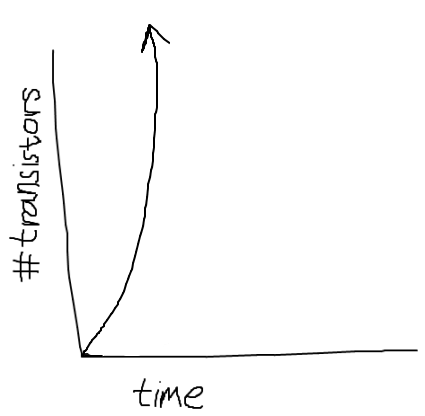
That graph looks linear, so what's the big deal? Look at the left - it's logarithmic scale. That graph really looks like this:
That slope is so high it's almost negative.
You can't keep up with everything - but you can't afford to be late to the party when it comes to new trends in development either. If you were a desktop application programmer in 1992 and didn't look up until 2002, you'd probably say a few WTFs, and then start drowing in all the information you'd need to get started programming web applications. There's a lot to learn in new paradigms.
So you need to anticipate changes. You might not be able to jump the gun on the next big thing, but at worst you'll have augmented your arsenal, and you can stay close to other trends as well. Reading blogs and staying current in news and even journals can help you find new, up and coming developments. Thinking about how things will change and backing your hypotheses up with evidence from the literature can be a worthwhile activity in that regard.
Looking ahead and being explicit about your skill development can mean the difference between being blind or being visionary.
Know that you'll be obsolete. Don't accept obsolescence.
How do you deal with the pressure to stay current? What new things are you learning?
Hey! Why don't you make your life easier and subscribe to the full post
or short blurb RSS feed? I'm so confident you'll love my smelly pasta plate
wisdom that I'm offering a no-strings-attached, lifetime money back guarantee!

Nice post. I couldn't agree more. If you don't stay current you'll suffer for sure. I experienced this first hand. One issue that I believe is true is that some full time jobs will keep you so busy putting out fires, attending meetings, etc that you won't have time to stay abreast with new and emerging technologies. Within the Flash/Flex circle I think it's critical to stay on top of the changes, especially within the last couple years. Things are changing so fast it's unreal. Personally every waking minute of my life is dedicated to staying on top of the changes and ever shifting technological ecosystem we know as 'The Flash Platform'. I gave up pretty much every other personal interest I had to keep up and stay ahead. A trend that I see continuing. Being a contractor helps with this because I don't get bogged down with excessive politics and non work related tasks while working. It's usually just about the work and nothing else. Anyway, just some thoughts from someone else with the last name Moore....
Posted by Sean Moore
on Jul 25, 2008 at 11:25 AM UTC - 6 hrs
This is a great post. I totally agree with this, I have been fire fighting for the past numerous years jumping from problem to problem and have found that my skills are no longer marketable. The company that I work for does not care because to them you are good at fire fighting for them.
The issue is finding the time and energy to do something about it while maintaing a personal life.
Working 12+ hour days trying to be a good father and husband can leave you burnt out.
So now I am trying to get back into things and catch up on FLEX and new Java Technlogies.
Posted by Eric Lewis
on Jul 25, 2008 at 02:56 PM UTC - 6 hrs
Great post. It's interesting to think about the growth of software frameworks and paradigms in terms of Moore's Law.
One small pedantic nitpick. You said: "That slope is so high it's almost negative." Slope = rise/run. A negative slope is one that is trending toward zero (a downward direction as moving to the right along the X axis). This one, however, is trending toward infinity.
Posted by Scott Mitchell
on Jul 25, 2008 at 03:56 PM UTC - 6 hrs
Great post.
I'm a CF and web developer and I personally try and spend a day a week (Friday's) working on new ideas.
I also try to attend a developer conference once or twice a year... and pretty much read blog posts every night.
I once heard that you are either moving forward or your moving backwards... but either way your moving.
If you want to be in this industry you have to be willing to learn.
Posted by Andrew Kamphuis
on Jul 25, 2008 at 04:08 PM UTC - 6 hrs
I read something similar from Zed Shaw today: "I’ve been saying for years that you can live a life involving code and hacking as a cultural phenomenon, but you can’t live a life that only has code. You can work and make money doing web programming, but you can’t make a life out if it. I try fill my mind and experiences with other shit, and then use code as one of many ways to express myself." (from http://www.zedshaw.com/conferences/rubyfringe_2008... near the bottom)
It's important to remember that.
@Scott Mitchell: If we /really/ wanted to be pedantic, we'd need to say something like "the slope of the tangent..." =) When I wrote it, I was envisioning the graph looking something like this:
\ ) _/
Put in words: technology and information is growing so fast that it would have an effect the info available in the past. Or, time travel would be possible in the future to where we could give the past more information. (Which would affect the future, and I guess this recursion would go so deep that the stack would explode, not just overflow).
I didn't have those words at the time. It was meant to be nonsensical, so those words fit as well as any, I suppose. =)
Posted by Sammy Larbi
on Jul 25, 2008 at 04:36 PM UTC - 6 hrs