I like email. It has so many advantages: The asynchronous nature means I can respond when I have time and you can do the same. I don't have to face you, so its easier to relate unpleasantries. I can take as much time to carefully craft
my words as I need. I can say
just the right thing. The list could get longer.
A lot of us really like computers more than we like people. We prefer
IM or
IRC to picking up the phone, and we prefer email over face-to-face conversation. Be honest, you'd rather be talking to
Johnny 5 than
Homo sapiens.
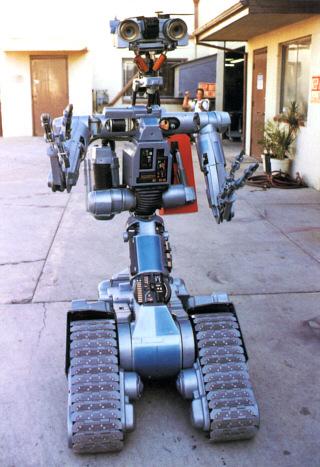 The problem is that most of the rest of the world doesn't share your distaste for people, and neither would you if you were depending on the person who chose not to communicate on a personal level
. To put a similar amount of information in an email as you could get in one
RL conversation could take tens of minutes to write (and subsequently read) compared to just a couple of minutes.
Just like Johnny 5, humans need "more input, more input!"
As Chad Fowler notes in the "Being Present" chapter of
My Job Went To India, business is personal. The bonds you form (or don't form) with your boss and coworkers affect how they treat and react to you. As he writes on page 131,
The natural work mode of a computer person is to hole up in a cubicle or office, put on a pair of headphones, and get into "the zone" until it's time to eat. Douglas Coupland, in his book Microserfs tells the entertaining story of a team having to buy flat food to slide under the office door of a programmer on a mission. This kind of isolation has become part of the culture and folklore of the software industry.
Unfortunately, speaking for your career, this is bad for business. If you're locked up in an office, accessible only by phone (if you answer) or e-mail, perhaps even working all hours of the night and sleeping late as a result, there's no difference between you being onsite with your bosses and your customers and being offshore. [Bold emphasis mine.]
No difference, except you probably get paid more. So how valuable are you then?
You are on-site and that puts you at an advantage. Use it. As I mentioned above, if the tables were turned - if you were depending on someone else - you'd not likely feel like a few short emails will suffice for communication.
From
my own recent experience, I can certainly say that's how I've felt. In this case, I'm the customer forking the money over to
my home builder. When we first met, he said he preferred communicating mostly through email. I thought to myself, "great, I won't have to call him or meet with him all the time."
That quickly changed as I noticed problems with the house. I wanted vocal reassurances. I wanted face-to-face meetings so I could express
my displeasure with the tile not matching without coming across like a jackass in email. I wanted to know when problems would be fixed - not just "I'll fix them" with no progress seen over two months. A simple, "We fix that kind of stuff at the end" would have gone miles. Sadly, I've only met with the builder a couple of times and spoke on the phone even less.
I'm completely uncomfortable with the situation. I feel out of control. I want to know what's going on and how we're going to fix the problems. But I get no reassurance - at least not as quickly as I'd like it.
Now I know how
my customers and coworkers and bosses feel when they don't get anything but short emails from me. They have queasy stomachs and feel sick. Hopefully, I won't let them feel like that again.
What do you think?
Hey! Why don't you make your life easier and subscribe to the full post
or short blurb RSS feed? I'm so confident you'll love my smelly pasta plate
wisdom that I'm offering a no-strings-attached, lifetime money back guarantee!
Leave a comment
There are no comments for this entry yet.
Leave a comment